
Tunes from The Jukebox!
If you enjoy Classic American Music with a nostalgic touch, then you've come to the right place. Just Page Down to see some of my selections....
(Click on the photos and highlighted text for more info. When you want to return just click "Back" above)
My LATEST Selection:
Click HERE to hear the soundtrack for a rare 1961 RCA VICTOR Color TV Ad:
"Wow! I Saw Color TV!"
If you didn't have a color set before the commerical, you'd get one soon. Very persuasive. Very catchy.
I heard this commercial once, as a child and never forgot it or the tune. It took over 45 years to find it again and it's just as I remembered it.
Presented 11/2006
 Hey,
hey! They're The Monkees! Still are. And they remain one of the best
"manufactured" groups of all time. Truly the 1960s equivalent
of the "Spice Girls", these four, high-spirited youngsters exploded
onto the music scene and television screens in 1966 with a burst of psychedelic
color and a healthy dose of good-hearted irreverence towards the establishment
of the time. Hip, yet wholesome. And, why not? They were brought to us each
week by Kelloggs, ("The Best to You Each Morning") of Battle creek.
Now, to explain the term "manufactured" I mean that the folks
at Columbia Pictures' subsidiary Screen Gems Television did everything they
could to ensure the success of this group, both on the tube and in the record
stores. Surveys were taken, focus groups consulted, casting calls posted,
interviews conducted and, as a result, these four fellows, (Mike Nesmith,
Mickey Dolenz, Davy Jones and Peter Tork) were selected to become "The
Monkees", a new pop musical group. Never mind the fact that only two
of them had any kind of musical experience and only one could play a musical
instrument himself, they were perfect! And they were, too. Statistics don't
lie.
Hey,
hey! They're The Monkees! Still are. And they remain one of the best
"manufactured" groups of all time. Truly the 1960s equivalent
of the "Spice Girls", these four, high-spirited youngsters exploded
onto the music scene and television screens in 1966 with a burst of psychedelic
color and a healthy dose of good-hearted irreverence towards the establishment
of the time. Hip, yet wholesome. And, why not? They were brought to us each
week by Kelloggs, ("The Best to You Each Morning") of Battle creek.
Now, to explain the term "manufactured" I mean that the folks
at Columbia Pictures' subsidiary Screen Gems Television did everything they
could to ensure the success of this group, both on the tube and in the record
stores. Surveys were taken, focus groups consulted, casting calls posted,
interviews conducted and, as a result, these four fellows, (Mike Nesmith,
Mickey Dolenz, Davy Jones and Peter Tork) were selected to become "The
Monkees", a new pop musical group. Never mind the fact that only two
of them had any kind of musical experience and only one could play a musical
instrument himself, they were perfect! And they were, too. Statistics don't
lie.
Using some of the best popular song writers of the time, and managed by the legendary Don Kirshner, (of "Don Kirshner's Rock Concert" fame) "The Monkees" faked their way to the top of the charts. Their first recordings featured instrumental accompaniment by other performers but, over time, the plucky foursome learned their craft and demanded control of their musical material, remaining successful for close to four years, (which, for popular music, is an eternity).
Now, many, (if not all) of the recordings from that prolific time period of their's are available on CD, both as reissues of originally released albums or as modern compilations of previous work, but I have found "The Monkees Greatest Hits" to be one of the most comprehensive of the repackaged recordings. Included on this 1995 release by Rhino Records, are most of "The Monkees" more memorable ditties ranging from the legendary, (if not inspired) theme from their TV show "The Monkees" to "Daydream Believer" and "Last Train to Clarksville". Most of their big hits are here, (though I must admit I did miss "Auntie Griselda"). There are also some of the group's later efforts from their mid 1980's comeback like "That Was Then,This Is Now", though the latter selections have little in the nostalgic vein to endear themselves to me. Still, "The Monkees Greatest Hits" is a proud inclusion in The Sweatbox Lounge's Jukebox collection and ,if you are a fan, could be one that your own, too. Just click on "Rhino Records" above to go to the Rhino web site. Then, shop around and have a "Pleasant Valley Sunday".
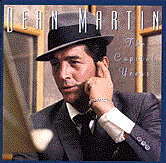 Truly
one of the most underrated performers of our time, according to his once
partner Jerry Lewis, Dean Martin is, in recent years (and more notably since
his death in 1995), experiencing a major popularity resurgence and one that
is well deserved. His easy, graceful manner and pleasant, relaxed approach
to performance has endeared him to many over the years and is, at once,
distinctly '50s or more specifically, Italian '50s. Who can forget "That's
Amore", "Memories Are Made Of This" or "Ain't That A
Kick In The Head"? His songs are used quite effectively to set the
tone for many of today's top films such as "Moonstruck", "L.
A. Confidential" and "Swingers". Be they period pieces or
tales of contemporary hipsters, Dino's crooning voice immediately says cool
without being corny. Indeed, his new found popularity has many record labels
scrambling to issue as many different compilations of this prolific man's
work as they can. There's a lot of good stuff out there too, but never has
Dino sounded better than the years he spent at Capitol Records in Hollywood,
particularly the years from 1953-1960. During this time, Dean recorded many
wonderful, popular standards in that laid back, two martini warble that
was unmistakably his. Many of these recordings feature arrangements by such
greats as Paul Weston, Nelson Riddle and Billy May.
Truly
one of the most underrated performers of our time, according to his once
partner Jerry Lewis, Dean Martin is, in recent years (and more notably since
his death in 1995), experiencing a major popularity resurgence and one that
is well deserved. His easy, graceful manner and pleasant, relaxed approach
to performance has endeared him to many over the years and is, at once,
distinctly '50s or more specifically, Italian '50s. Who can forget "That's
Amore", "Memories Are Made Of This" or "Ain't That A
Kick In The Head"? His songs are used quite effectively to set the
tone for many of today's top films such as "Moonstruck", "L.
A. Confidential" and "Swingers". Be they period pieces or
tales of contemporary hipsters, Dino's crooning voice immediately says cool
without being corny. Indeed, his new found popularity has many record labels
scrambling to issue as many different compilations of this prolific man's
work as they can. There's a lot of good stuff out there too, but never has
Dino sounded better than the years he spent at Capitol Records in Hollywood,
particularly the years from 1953-1960. During this time, Dean recorded many
wonderful, popular standards in that laid back, two martini warble that
was unmistakably his. Many of these recordings feature arrangements by such
greats as Paul Weston, Nelson Riddle and Billy May.
From a technical standpoint, I would also like to note that Capitol recordings
are some of the best available from this time period, due in part to the
rich, warm Capitol sound, achieved by Capitol's state-of-the-art recording
equipment of the day. One such electronic marvel from the period was a wonderful
microphone, exclusive to Capitol Records, (shown below with Dean during
a 1950s recording session).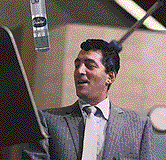 This microphone was so revered in the recording industry
that many artists asked for it at all of their sessions. If you look closely,
you will see this ubiquitous piece of recording hardware in many photographs
of the greats recording at Capitol throughout the 1950s, (see "Nat
King Cole, The Billy May Sessions" below) and I understand that a few
of these microphones are still operational and remain in demand by some
of the most discriminating recording artists of today.
This microphone was so revered in the recording industry
that many artists asked for it at all of their sessions. If you look closely,
you will see this ubiquitous piece of recording hardware in many photographs
of the greats recording at Capitol throughout the 1950s, (see "Nat
King Cole, The Billy May Sessions" below) and I understand that a few
of these microphones are still operational and remain in demand by some
of the most discriminating recording artists of today.
One of the more popular artists featured on The Jukebox at "The Sweatbox Lounge", this collection of some of Dean's Capitol recordings called, simply, "Dean Martin-The Capitol Years", says it all and remains one of my favorites of all the compilations of Mr. Martin's music available at the present time. I believe that some of his best work is included on this 2 CD set, even some never before released selections, cameo appearances by Peggy Lee, Jerry Lewis and Nat King Cole and a great personal introduction by Dino, himself. A must for any serious collector of popular music of the 1950s and a great companion for any impromptu Italian meal. So the next time the moon hits your eye like a big pizza pie, give this recording a try. Buy-Bye.
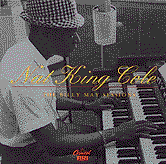 Everyone knows Nat King Cole. He's the one that sang
with his daughter in 1990, 25 years after his death. Brrrrrrrrr. Scary!
But seriously, the successful jazz pianist turned reluctant singer has a
voice that is renown as being one of the most soft and romantic ever recorded.
It would be difficult to find anyone who does not know who Nat King Cole
was, even if it were just to say he was Natalie Cole's father. I have always
loved Nat King Cole. "Mona Lisa", "Tenderly", "Route
66" and "The Christmas Song" are all cherished standards
and, in my humble opinion, no less than national treasures. Nat's hit-studded
recording career has spanned decades, his popularity skyrocketing him to
fame almost from the very start, through his untimely death, from cancer,
in 1965.
Everyone knows Nat King Cole. He's the one that sang
with his daughter in 1990, 25 years after his death. Brrrrrrrrr. Scary!
But seriously, the successful jazz pianist turned reluctant singer has a
voice that is renown as being one of the most soft and romantic ever recorded.
It would be difficult to find anyone who does not know who Nat King Cole
was, even if it were just to say he was Natalie Cole's father. I have always
loved Nat King Cole. "Mona Lisa", "Tenderly", "Route
66" and "The Christmas Song" are all cherished standards
and, in my humble opinion, no less than national treasures. Nat's hit-studded
recording career has spanned decades, his popularity skyrocketing him to
fame almost from the very start, through his untimely death, from cancer,
in 1965.
Billy May, on the other hand, known more for his brash, punchy, explosive big band sound, is hardly a household word. Even before I followed the work of arrangers in the recording industry I found myself unknowingly attracted to his unmistakable, swinging style. I originally singled out his arrangement of "This Must Be The Place", sung by Tennessee Ernie Ford and Betty Hutton. I latched onto him again in Nat King Cole's "Walkin' My Baby Back Home" and eventually got to know him better listening to his work as musical director for Stan Freberg's hilarious, (albeit short lived) CBS radio show in 1957. May's distinctive trademark sound is what has been described as "Slurping Saxophones" and you can get a good idea of what they mean by this listening to "Walking My Baby Back Home", the first track of disc 1. That May sound is right there up front. In fact, for a long time whenever I would hear a piece that I really liked the arrangement on, I would check the label and there he'd be, Billy May. What Nat King Cole was to the tender, sentimental love ballad, Billy May was to the full, swinging, orchestral arrangement. So, if their styles are so dramatically different, how did two so obviously miss-matched musicians get together to produce so much wonderful music? The answer is, perfectly.
Friends since 1941, their paths would cross a number of times professionally, mainly due to both of their long-term relationships with Capitol Records. In fact, at one point in 1947 the two men even wrote a novelty song together for the Capitol label, called "Ooh, Kickerooney". But it wasn't until 1951 that Carlos Gastel, (Cole's Manager) and Lee Gillette, (who was producing both artists at the time) paired May with Cole in an effort to replace the recently departed Stan Kenton and his Orchestra, who had, a few years earlier, backed up Nat on the wildly successful "Orange Colored Sky". The big hit to come out of this early Cole-May session turned out to be "Walkin' My Baby Back Home", an old tune that May transformed into about as swinging a ballad as you will ever hear. But, financial success aside, this hit immediately served to point out that this most unlikely of pairs complimented each other's styles perfectly and paved the way for a number of other big hits for the duo.
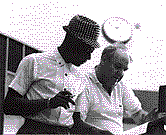 Over
the next decade, they continued to spice up many old standards, while popularizing
new ones. And, when it came time to cash in on the Latin dance craze of
the 1950s and '60s, Billy rose to the occasion by drawing on the experience
he had, playfully arranging and conducting a series of Capitol dance records
from the late 1940s, under the name "Rico Mambo and the Rico Mambo
Orchestra". The delightful result, when Cole's vocals were brought
into play , was a number of popular Latin rhythm hits, not the least of
which is the brilliantly clever "Papa Loves Mambo".
Over
the next decade, they continued to spice up many old standards, while popularizing
new ones. And, when it came time to cash in on the Latin dance craze of
the 1950s and '60s, Billy rose to the occasion by drawing on the experience
he had, playfully arranging and conducting a series of Capitol dance records
from the late 1940s, under the name "Rico Mambo and the Rico Mambo
Orchestra". The delightful result, when Cole's vocals were brought
into play , was a number of popular Latin rhythm hits, not the least of
which is the brilliantly clever "Papa Loves Mambo".
The Cole-May collaboration ran the gamut of styles ranging from classical with "Moon Love" and "Ebony Rhapsody" (Inspired by Tchaikovsky and Franz Liszt, respectively), through early Rock and Roll, with the quasi doo-wop sound of "Blue Moon" and "Let's Make More Love", even toying with country in their rendition of Hank William's, "Cold, Cold Heart" before their final collaboration on the 1961 LP release, "Let's Face The Music And Dance", which featured a couple of my personal favorites, "Bidin' My Time" and "Something Makes Me Want To Dance".
This Capitol Jazz 2 CD release showcases that wonderful collaboration of Billy May and Nat King Cole with over 40 marvelous representations of this noteworthy alliance, bridging the entire span of their work recorded at Capitol from 1951 to 1961. I regard "Nat King Cole-The Billy May Sessions" as a treasured member of my popular music collection. From the first track you will understand what I am talking about and then you will undoubtedly cherish this collection as much as I.
 Knowing
what you now know about my love and respect for the work of Billy May, it
may or may not surprise you to hear that, without hesitation, I would have
to place Nelson Riddle right up there by Billy's side. Nelson was one of
the most incredible arrangers in pop music history. Not only did he work
with virtually every big name vocalist in town, including Frank Sinatra,
Nat King Cole, Judy Garland and, of course, Rosemary Clooney, he also scored
"Pal Joey" and "Pajama Game" for the motion picture
screen, winning an Academy Award in 1975 for "The Great Gatsby".
A little known fact is that he also penned the theme for the original science
fiction movie "The Blob" in 1957.
Knowing
what you now know about my love and respect for the work of Billy May, it
may or may not surprise you to hear that, without hesitation, I would have
to place Nelson Riddle right up there by Billy's side. Nelson was one of
the most incredible arrangers in pop music history. Not only did he work
with virtually every big name vocalist in town, including Frank Sinatra,
Nat King Cole, Judy Garland and, of course, Rosemary Clooney, he also scored
"Pal Joey" and "Pajama Game" for the motion picture
screen, winning an Academy Award in 1975 for "The Great Gatsby".
A little known fact is that he also penned the theme for the original science
fiction movie "The Blob" in 1957.
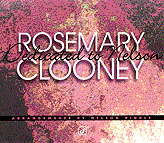
Nelson worked for decades on the best arrangements in the business, but it was in the 1950s that he was really the king of that swinging sound with hit albums like Sinatra's "Songs For Swinging Lovers" and Nelson's own "Hey Let Yourself Go". Still, he always lamented that arrangers spent their lives perpetuating song-writers and receiving little attention in the bargain. It wasn't until his collaboration with Linda Ronstadt in the mid 1980s that he really achieved the acclaim as an arranger that he had earned over a lifetime of work. Through the years he did it all, but few had the kind of musical kinship that Riddle and Rosemary Clooney had.
Nelson and Clooney were very close, Riddle serving as musical director and arranging all the material for Rosie's late '50s television show, a gig that would eventually lead him to do much more high profile television work arranging music for "The Untouchables", "Route 66" and even into the '80s with the theme for "Newhart". So, it was only fitting in the '90's that Ms. Clooney, with the help of her long time musical director John Oddo, would set about putting together this wonderful tribute album to Nelson Riddle using the very musical arrangements he prepared 35 years earlier for her now famous television series.
 To prepare the material for recording "Dedicated
To Nelson", Clooney and Oddo had to do something that had never been
done before. The two had to audit dozens of soundtrack tapes from the TV
show, (as none of the original written scores survived) and transcribe them,
note for note. Some needed to be fleshed out a little because, being written
for television, many of the pieces were too short for this new project.
Then, Rosie herself selected about 16 of the best songs to be included on
this newly recorded disc, the criterion for selection being that they had
to "speak" to her with the meaning and simplicity that she and
Nelson had long been famous for.
To prepare the material for recording "Dedicated
To Nelson", Clooney and Oddo had to do something that had never been
done before. The two had to audit dozens of soundtrack tapes from the TV
show, (as none of the original written scores survived) and transcribe them,
note for note. Some needed to be fleshed out a little because, being written
for television, many of the pieces were too short for this new project.
Then, Rosie herself selected about 16 of the best songs to be included on
this newly recorded disc, the criterion for selection being that they had
to "speak" to her with the meaning and simplicity that she and
Nelson had long been famous for.
Surrounding herself with some of the best studio musicians of today and performing in her wonderfully mature, almost gravely vibrato, the result of this project is so unique and personal that you can actually hear in every note, the love and admiration that this woman held for this man's work. "Dedicated To Nelson" is a labor or love and a crowning achievement in the stellar career of one of America's greatest ladies of song. Give it a listen and you will agree. As stated in the disc's liner notes, "Rosemary Clooney sings the truth".
 There
is nothing quite like a Cole Porter tune, is there? So witty and sophisticated.
Melodic and memorable. Eloquent, yet accessible. I think that's why so many
Porter tunes have become popular standards, standing the test of time. Vocalists
love to perform them and, for over 70 years, most of the best performers
have. One theory I developed for why these songs endure and are always in
demand is the fact that they are just so much fun. With bright, clever,
romantic, and sometimes even wistful melodies and lyrics like "...You'd
be so nice. You'd be paradise..." or "It's Delightful, It's Delicious,
It's Delovely", how could they be anything but wonderful either to
perform or to listen to.
There
is nothing quite like a Cole Porter tune, is there? So witty and sophisticated.
Melodic and memorable. Eloquent, yet accessible. I think that's why so many
Porter tunes have become popular standards, standing the test of time. Vocalists
love to perform them and, for over 70 years, most of the best performers
have. One theory I developed for why these songs endure and are always in
demand is the fact that they are just so much fun. With bright, clever,
romantic, and sometimes even wistful melodies and lyrics like "...You'd
be so nice. You'd be paradise..." or "It's Delightful, It's Delicious,
It's Delovely", how could they be anything but wonderful either to
perform or to listen to.
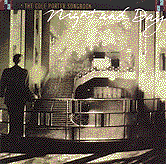
Couple the brilliance of Porter with great vocalists and the superb tonal quality of Verve Records and you have a terrific way to listen to these master works in "Night and Day". This Incredible compilation is, quite possibly the best of a three disc release by Verve Jazz in 1990 known as "The Cole Porter Songbook". Here, Louis Armstrong, Ella Fitzgerald, Sarah Vaughan and Blossom Dearie are only a small sampling of the stellar performers that bring to life some of the best loved Cole Porter tunes of all time. Beautiful renditions of "Anything Goes", "I Get A Kick Out Of You" and the title song, "Night and Day" recorded from 1952 through 1963 and presented, one right after the other in a relaxed, almost nightclub style, on 17 brilliant tracks. The other two discs in the set offer great instrumentals on "Anything Goes" and more great vocals on "I Get A Kick Out Of You", but neither of these latter two have the same style or energy as the original "Night and Day". Check them out and you'll see. They are truly as different as night and day.
 Most people of my generation are familiar with Jimmy
Durante as an older man, if we know him at all. I mostly remember seeing
him on television in Kellogg's Cornflakes commercials of the early '60s.
Some of us have brushes with the younger Durante by viewing clips from his
old appearances in movies and cartoons of the 1930s and '40s. But it matters
little which Durante we remember, he was always the same. Old beyond his
years. His most notable feature, clearly visible even in early, grainy television
kinescopes, is a rather large nose which he lovingly referred to throughout
his career as his "schnozzola", the never ending butt of good
natured elephant jokes. But despite the gentle ribbing, by all accounts,
this man was one of the most beloved people ever to grace the screen or
set foot in a recording studio. That's right, Mr. Durante had quite a successful
recording career.
Most people of my generation are familiar with Jimmy
Durante as an older man, if we know him at all. I mostly remember seeing
him on television in Kellogg's Cornflakes commercials of the early '60s.
Some of us have brushes with the younger Durante by viewing clips from his
old appearances in movies and cartoons of the 1930s and '40s. But it matters
little which Durante we remember, he was always the same. Old beyond his
years. His most notable feature, clearly visible even in early, grainy television
kinescopes, is a rather large nose which he lovingly referred to throughout
his career as his "schnozzola", the never ending butt of good
natured elephant jokes. But despite the gentle ribbing, by all accounts,
this man was one of the most beloved people ever to grace the screen or
set foot in a recording studio. That's right, Mr. Durante had quite a successful
recording career.
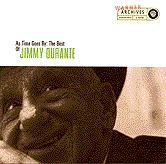
From his earlier, trademark tunes like "Umbriago" and "Inka Dinka Doo" it is instantly apparent that Mr. Durante is not a refined singer, but you won't hear any of these novelty songs on "As Time Goes By: The Best Of Jimmy Durante" anyway. The tracks on this disc were cut in 1963, late in Durante's career, and feature timeless, classic melodies including "Make Someone Happy", "Young at Heart" and Charlie Chaplin's own "Smile". What you do find on this disc, however, is a genuine and forthright quality that is at once sentimental without being cloying or maudlin.There is something about Durante's performance that transcends his vocal limitations in much the way he overcame similar limitations on the big screen in the form of a, shall we say, less than chiseled profile. Jimmy's renditions in this compilation have such tremendous heart that the depth of his feelings leap right off the disc at the listener in a way that many more "developed " performers might only hope to achieve. As Jimmy, once, so aptly put it, "Sometimes I sing so pretty I like to break my own heart". These recordings have "meanin'" and "feelin'". In fact, in his vocabulary, Durante used g's sparingly at best. But, that's okay in my book, as long as he keeps on singin'.
Durante was a wonderful, likable man, as is clear in testimonials from all of his contemporaries and it is amazing to watch, even today, when I play a selection from this CD, how people immediately stop what they are doing and just beam. The man must have been doing something right because this disc is one of the most requested in my collection. When Mr. Durante sings, people listen. "Them is the conditions that prevails."
3/98
Dear Friends;
Thanks for your interest in my Jukebox selections. I hope, if you should choose to take any of my recommendations, that you will enjoy them as much as I have. Please return to "The Jukebox" from time to time, as I plan to change out these discs periodically to make room for future selections. If you have a request or comments, please drop by the Valet Parking lot to drop me a line. I will make every attempt to respond as quickly as possible.
If you are interested in researching where to find and/or buy some of the selections I review on this page, below are some Web Sites Links to click on. These may possibly help you in this endeavor. Best wishes to you and many thanks.
Sincerely,
Dave Pruiksma
3/98
Related Links:
[ CDnow / Tower Records / Collector's Choice Music]
Back to the Diner...